
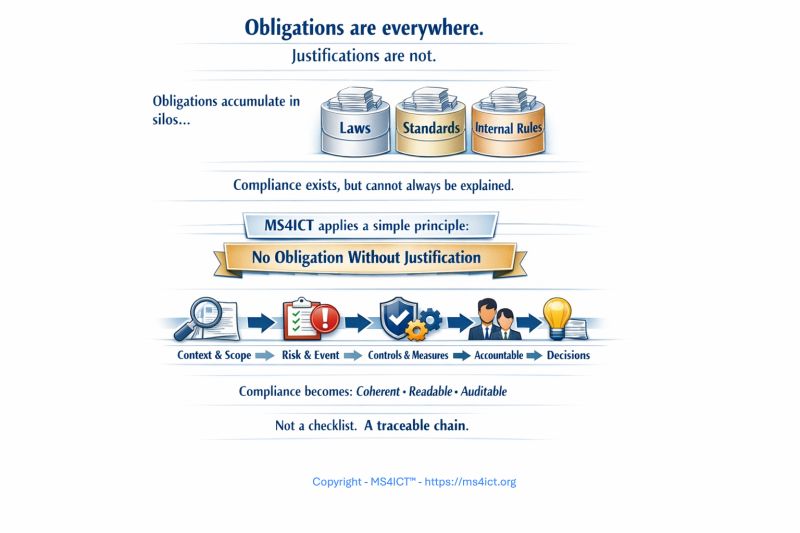
In today’s digital environment, organizations are facing an ever-growing number of obligations:
international standards, regulatory requirements, contractual constraints, and internal policies.
- ISO 27001, NIS2, DORA, GDPR, AI Act…
- Each framework introduces its own set of requirements.
Yet despite this accumulation, one issue remains consistent:
obligations exist, but their justification is often missing.
This creates a system where compliance is present… but rarely understood, managed, or leveraged.
The Real Problem: Isolated and Disconnected Obligations
In most organizations, obligations are:
- managed in silos (IT, cybersecurity, legal, compliance…)
- interpreted differently across teams
- implemented without clear linkage to actual risks
This leads to immediate consequences:
- duplicated controls
- unnecessary complexity
- difficult audits
- lack of clarity for leadership
More importantly:
An obligation without justification is perceived as a constraint—not as a decision driver.
Understanding the True Role of an Obligation
An obligation is not just a regulatory requirement.
It plays a structural role in governance:
- it translates external constraints into internal processes
- it enforces organizational behavior
- it aims to reduce or manage risk
However, when taken in isolation, it loses its purpose.
Without context, an obligation becomes:
- an abstract rule
- an operational burden
- a cost with no visible value
Why Compliance Is Perceived as a Cost
In unstructured environments, compliance suffers from several limitations:
1. Lack of Risk Connection
Obligations are not tied to concrete risk scenarios.
2. Lack of Explainability
Teams implement controls without understanding their purpose.
3. Operational Redundancy
Multiple obligations generate overlapping or duplicated controls.
4. Limited Decision Support
Leadership cannot effectively prioritize investments.
The outcome:
compliance is perceived as a cost center instead of a governance tool.
The MS4ICT Approach: Risk-Based Governance
MS4ICT provides a structured and unified response to this challenge.
Its core principle is simple:
Every element must be coherent, traceable, and explainable.
The methodology is built on an integrated architecture that connects:
- organizational context
- risk events
- risks
- obligations
- controls
- responsibilities
The objective:
to create a fully traceable and justified decision chain.
No Obligation Without Justification
At the heart of MS4ICT lies a fundamental rule:
No obligation without justification
In practice, each obligation must be linked to:
🎯 1. Context
- scope
- critical assets
- business priorities
⚠️ 2. Risk Event
- incident scenario
- threat or failure
📊 3. Risk
- potential impact (financial, operational, regulatory, reputational)
📜 4. Obligation
- applicable regulatory or normative requirement
🛠️ 5. Control
- measure designed to mitigate the risk
👤 6. Responsibility
- accountable role
The Coherence Engine: The Core of the Model
MS4ICT does more than structure information.
It connects all elements through a coherence engine.
This enables organizations to:
- trace every decision
- justify every control
- eliminate inconsistencies
- align cross-functional teams
This is no longer just compliance management.
It is a risk-driven governance system.
From Compliance Burden to Strategic Lever
When this approach is applied, perception changes dramatically:
Before
- obligations are imposed
- controls are reactive
- limited visibility
- complex audits
After (MS4ICT)
- obligations are justified
- controls are risk-aligned
- decisions are traceable
- governance becomes strategic
Value Creation for the Organization
MS4ICT transforms compliance into measurable value:
✅ Optimized Investments
Resources are allocated where risks are real.
✅ Reduced Hidden Costs
Elimination of redundancy and inefficiencies.
✅ Better Communication
A shared language across IT, compliance, and leadership.
✅ Enhanced Auditability
Every decision is explainable and defensible.
✅ Business Alignment
Obligations are linked to business priorities.
A Shift in Mindset: From Control to Decision
The real transformation is cultural.
Organizations move from:
➡️ “We must implement this control”
to
➡️ “This control mitigates a critical risk and addresses a specific obligation”
This shift is central to MS4ICT.
Conclusion: Restoring Meaning to ObligationsObligations are not the problem.
Their isolation is.
MS4ICT does not introduce additional complexity.
It structures what already exists.
It reconnects:
- obligations
- risks
- controls
- decisions
And transforms compliance into a driver of governance and performance.
📘 Call-to-Action
Want to understand and implement this approach?